What replaces forecasting
Everyone knows the forecast is inexact. The strange part is that the entire planning system is still built to obey it.
October 2026
Ask anyone in operations whether next quarter's forecast is accurate and you will get a knowing smile. Everyone knows it is inexact. Everyone has always known. And yet the planning system — the MRP run, the production schedule, the purchasing plan — takes that forecast and treats it as truth, pushing material into the plant on the assumption that what was predicted this time is what will happen.
When it doesn't, and it never quite does, the response is almost always the same: get a better forecast. More data, more sophisticated models, more meetings to reconcile the numbers. A generation of planning effort has gone into making the prediction less wrong.
It has not worked, and it cannot, because the problem was never forecast accuracy. At the level where it actually matters — this item, this week — demand is genuinely uncertain, and no model removes that uncertainty. Worse, a forecast-driven system amplifies its own error: a small change in the projection ripples upstream into large swings in orders, inventory, and expediting — the bullwhip that every operation knows and few escape. The harder you push a forecast through the system, the more the system whipsaws.
The reframe is the whole point. You do not need a better forecast. You need an operation that does not depend on the forecast being right.
That is what a Demand Driven model does. Instead of pushing material from a prediction, it positions strategic decoupling points through the flow — buffers placed exactly where variability does the most damage — and then replenishes them based on actual consumption, not projected demand. Real signals, not forecast signals, drive execution. The forecast does not disappear; it moves to where it belongs — planning capacity, ordering long-lead items — and stops driving the day-to-day. The plant stops chasing a number and starts responding to what is actually being pulled from it.
This is not a philosophy or a mindset. It is an engineered operating model — DDMRP and the broader Demand Driven Operating Model — with explicit rules for where to place buffers, how to size them by lead time and variability, and when to replenish. It has been implemented in enough plants, across enough industries, to be proven, not experimental. The documentation is public; the logic can be taught in a week.
None of this is only about consumer demand. Many plants have no market forecast to speak of; they build to whatever their next-tier industrial customer orders, jumping each time that customer's schedule moves. That feels like responding to real demand — and in a sense it is. But when every tier in the chain forecasts and buffers on its own, a small wobble at the end customer amplifies as it climbs: the same bullwhip, now propagating across companies instead of departments. Toyota solved this not with a better forecast but with architecture, extending pull outward in stages over three decades — from its own four walls to its suppliers, then to theirs — and leveling production so variation never traveled upstream. The West stalled at the first of those stages, flow inside its own walls, and never built the rest. The Demand Driven suite — DDMRP for execution, the Demand Driven Operating Model above it, the Demand Driven Adaptive Enterprise above that — is how a Western supply chain can finally build that same multi-echelon pull: not through the decades of keiretsu relationships Toyota needed, but through method. It is, in effect, a way to mimic what Toyota achieved in Stages Two through Four1 — the part of TPS the toolkit left behind.
The method has never been the hard part — what it asks you to give up is.
What changes is what leadership pays attention to. Forecast attainment stops being the headline number, because the system no longer lives or dies on it. Flow becomes the headline instead: how quickly material moves, whether the buffers are sitting in their intended zones, whether the constraint stayed fed, whether orders shipped on time in full. The monthly planning meeting stops relitigating the forecast and starts asking a different question — whether the operation is positioned to absorb whatever demand actually brings.
That shift is harder than it sounds, because it asks people to give up something they have been rewarded for their entire careers. The supply chain specialist who could defend the forecast, reconcile the variances, and produce the number on time was doing the job as it was defined. A Demand Driven operation defines the job differently: not predicting demand, but engineering the system that meets it without prediction. The skill that mattered most becomes the skill that matters least.
The real obstacle, then, is a belief rather than a technique — the belief, held longest by the people most senior in marketing or supply chain, that somewhere out there is a forecast good enough to run the plant on, and that the job is to find it. Letting that belief go feels like surrendering control. It is the opposite. Control was never in the prediction; it was always in how the system is built to respond when the prediction fails — which it will, on schedule, every quarter.
The manufacturers who pull ahead over the next decade will not be the ones who finally cracked the forecast. They will be the ones who stopped needing to. The forecast was never a problem to be solved — it was a crutch. And the first operations to set it down will be the ones still standing when demand does what it has always done: something no one saw coming.
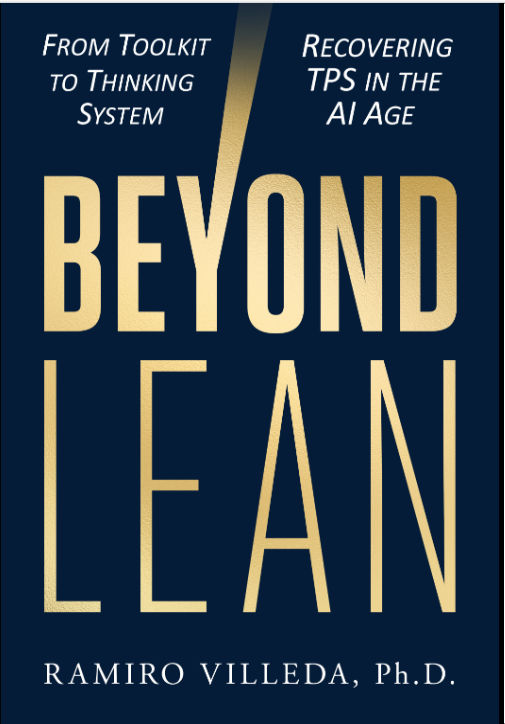
Ramiro Villeda is the founder of Villeda Consulting Group, Inc. and author of the book Beyond Lean: From Toolkit to Thinking System. He helps manufacturers move from forecast-bound planning to systems engineered for flow. Get in touch. Or go back.
© 2026 Ramiro Villeda. This article may be shared in full with attribution. It may not be reproduced in part, adapted, or used in training materials without permission.